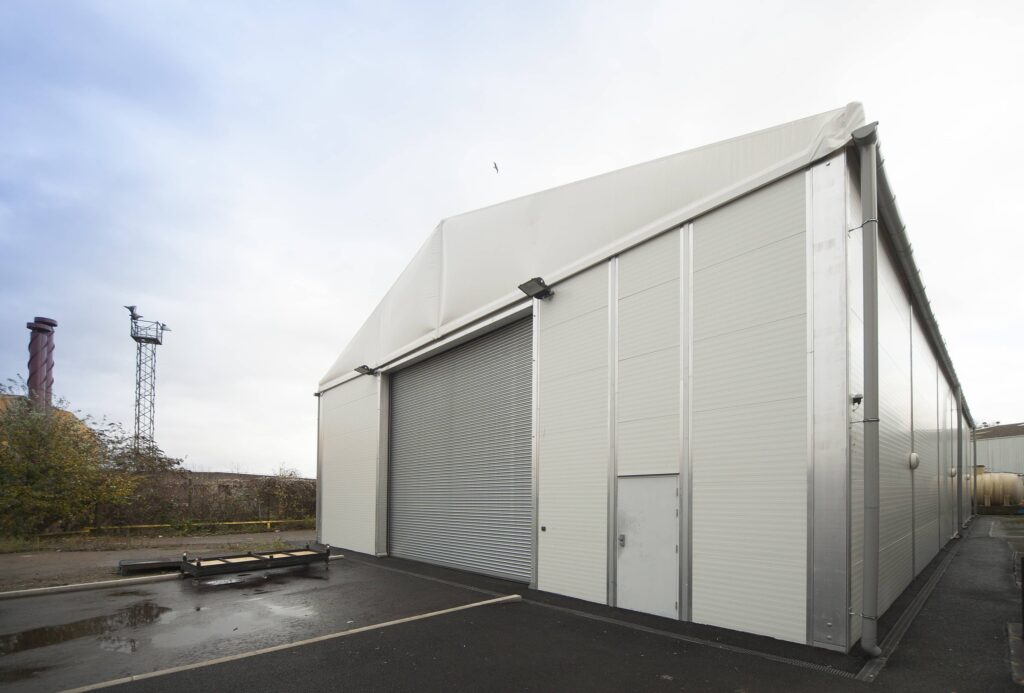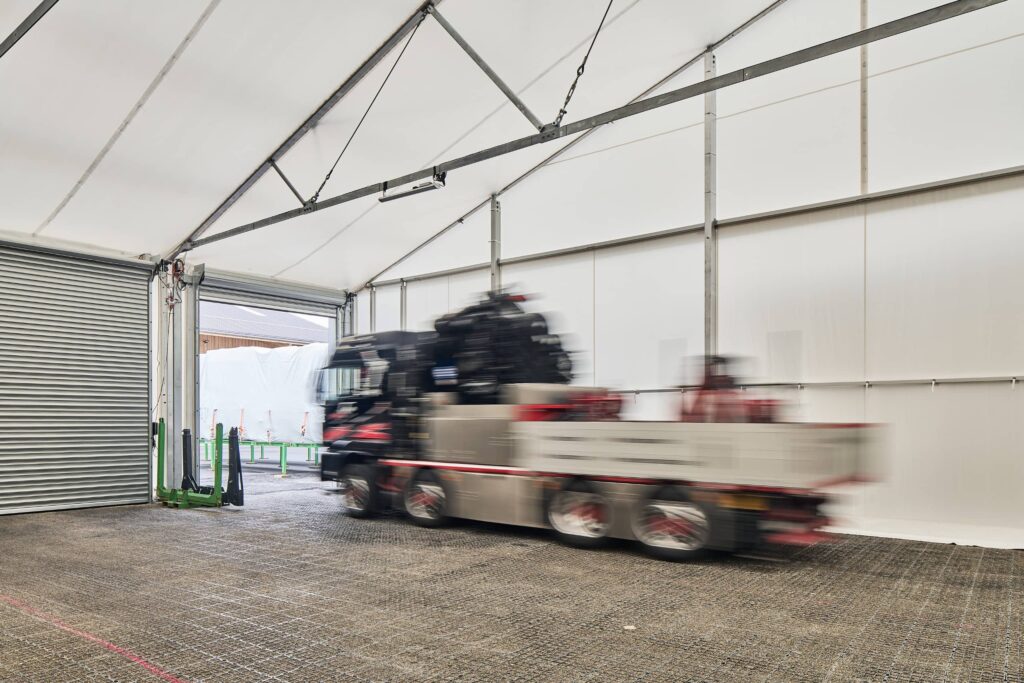
In this blog, we explain the rules around temporary structure planning permission, what counts as temporary, whether there are any exemptions and what the relatively recent changes in UK planning law mean for modular warehousing.
Quick summary: When do you need planning permission for a temporary structure?
| Your situation | Is planning permission usually needed? |
| Structure in place for 28 days or fewer in a calendar year | No. It should fall under permitted development |
| Site huts, cabins or storage for the duration of construction work | Often, no. This is covered within permitted development rights |
| Structure in place for more than 28 days for a non-construction use | Yes. Apply for temporary planning permission for the duration |
| Structure in a conservation area, National Landscape (AONB) or on/near a listed building | Often, yes. Permitted development is often restricted within conservation areas |
| An Article 4 Direction applies to your site | Yes. Permitted development rights may be removed |
| Markets, car boot sales or motor sport use | Limited to 14 days before planning permission is needed |
All advice here should be treated as a starting point only and not a ruling. The local authority has the final say and the safest way to avoid challenges and expensive penalties is to confirm your position with them or apply for a Certificate of Lawful Development. HTS Industries can advise you on this process.
What counts as a temporary structure?
A temporary structure is any building or unit designed to be put up and then used for a limited period before it is removed. This could include marquees, temporary warehouses, event stages, site accommodation or modular cabins during renovations.
When it comes to planning permission, temporary is about how long the unit will be in situ and what it is used for, not what it is made of. This means a steel-framed unit that will be removed after use is fine, but a lightweight structure left permanently in place will require planning. This is crucial as the permitted development rights that let you avoid planning permission are tied to the structure genuinely being “temporary”.
What determines if I need planning permission for a temporary structure?
There is a lot of confusion about temporary structures and whether planning permission applies. This is partly because many people seem to believe in a one-size-fits-all approach. In fact, three separate permitted development rights can apply, under Parts 4 and 7 of the Town and Country Planning (General Permitted Development) Order 2015. Which one applies to your business is down to why the structure is there, for what use and where it is going.
Class A: Temporary buildings for construction work
Class A is different. It allows buildings, moveable structures, plant or machinery to be placed on land temporarily in connection with, and for the duration of, construction or engineering operation on that land or land that adjoins it. This is typically what covers builder’s site cabins, offices and storage on an active construction site with planning granted.
Unlike Class B, there is no fixed day limit under Class A exemption. The structure can remain in place for the duration of the work, but two conditions apply:
- The structure must be removed once the work is finished and the land reinstated.
- It only works if the construction work itself has planning permission (or it has been deemed as not necessary). You cannot use the Class A clause to place cabins on a site whose main development doesn’t yet have consent.
The structure must genuinely support the construction work rather than provide a convenience. A cabin for a business admin operation rather than being there to support the construction works would fall outside Class A.
Class B: Temporary use of land (28-day rule)
Class B allows you to use any land for any purpose for up to 28 days in total in any calendar year, including placing a moveable structure on that land for any commercial use. This rule applies to pop-up events, temporary markets, seasonal uses and short-term storage on open land.
However, there are key limits to be aware of:
- If the use is for a market, car boot sale or motor racing, the allowance drops to 14 days.
- The land cannot be a building or within the grounds of a building.
- The 28 days do not need to be consecutive. They can be spread throughout the year, but the structure and any equipment must be removed between uses.
- Since 26 July 2024, Class B can no longer be used for camping unless it is in connection with a festival. A separate right, known as Class BC, now covers temporary recreational campsites for up to 60 days a year with no more than 50 pitches.
Class H: Adding an industrial building to an existing site
Class H sits under Part 7 of the GPDO and is the route most likely to apply if you are putting a temporary industrial building or demountable warehouse on a site that already has other industrial units. Unlike the 28-day limit, there is no time limit, but there are size and on-site building locations rules (known as siting limits) to be aware of. You can erect an industrial building or warehouse within the curtilage of an existing one without the need for planning permission as long as:
- The new building’s gross floor space is no more than 200m² (or 100m² on designated land such as National Landscapes, or on a site of special scientific interest).
- It stays at least 5.00m from any boundary of the site’s curtilage.
- It does not exceed 5.00m if it is within 10.00m of the boundary. Elsewhere it must not be taller than the highest existing building in the curtilage (max 15.00m).
- It does not reduce the space available for parking or turning vehicles.
- The site is not within the curtilage of a listed building.
There is also a cap on how much you can add cumulatively. Broadly, no more than 50% of the original building’s floor space (or 1,000m², whichever is smaller), with tighter limits on protected land. On designated land, the new building must also use materials similar in appearance to the existing one.
When don’t you need planning permission for a temporary structure?
In many cases, planning permission is not needed for a temporary building or demountable structure, but it must meet one of the permitted development scenarios shown below to qualify:
- The structure is on open land and is used for 28 days or less in the calendar year.
- It’s a site cabin, welfare unit or storage placed on a site for the duration of construction work that already has consent.
- It’s a moveable structure supporting a lawful short-term use and is removed between uses.
However, permitted development rights are not guaranteed. In certain areas they can be restricted or removed. Conservation areas, National Landscapes and on or near listed buildings, as well as anywhere covered by Article 4 Directions, will often mean permitted development rights do not apply. As a result, always check with the council planning department first. HTS Industries can advise on planning considerations.
When do you need planning permission for a temporary structure?
Temporary planning permission is required when:
- The temporary structure will stay in place for more than 28 days for non-construction use.
- The use is a market, car boot sale or motor sport and will run beyond 14 days.
- The site falls within a conservation area, National Landscape, listed-building setting or is subject to an Article 4 Direction that restricts permitted development.
- The structure would result in a material change of use of the land or building.
You may see figures like a 200m² floor area, a 5.00m gap from the boundary or a percentage of the site quoted as blanket tests for temporary structures. These are real, but they belong to the Class H route, for industrial buildings on an existing industrial site. They don’t apply to the 28-day rule, which has no size limit at all. The mistake to avoid is mixing the two. Work out which route fits your situation (temporary land use, construction site or an addition to an existing industrial site), then apply that route’s limits. If you are unsure, check the specific class or contact your local planning authority or with HTS Industries – we can advise on planning considerations.
Recent changes to UK planning law
Despite some recent reports to the contrary, the 28-day framework has not been increased. During the Covid period, an “additional temporary use” allowance was in place, but this has now expired, with the standard 28-day allowance remaining in place (14 days for markets, car boot sales and motor sports). However, two developments are worth knowing, as follows:
Set up and take down count towards your 28 days
In 2025, a series of High Court rulings concerning festivals in Brockwell Park found that the council had acted unlawfully in certifying event use as permitted development. The problem was that the total period the land was out of its normal use (including installation and removal of temporary stages) was more than 28 days, even though the events lasted far less.
The court also rejected the idea of segmenting a run of uses to keep each part under the 28-day limit. This means that you must count the full period that your structure occupies the land, not just the days it is operational.
Camping and campsites: new rules since 2024
As we touched upon earlier, Class B no longer covers camping unless it’s festival-related, and the Class BC rights introduced in 2023 govern temporary recreational campsites, with prior approval required each year for sensitive sites such as flood zones.
If your project sits anywhere near the 28-day limit, these changes make it more important to log your dates carefully and confirm your position before you commit.
How to apply for temporary planning permission?
If your temporary structure falls outside permitted development, the process is similar to most other planning applications.
- Check with the local planning authority. Each council may have slightly different rules; checking in advance can save a lot of time and money.
- Submit an application through the Planning Portal. Include a planning statement setting out the planned use, duration, a site plan, layout, floor plan and more.
- Await the decision. The statutory target is 8 weeks for most minor applications and 13 weeks for larger schemes; however, timelines can vary depending on the complexity of the structure and the location.
Can you apply for planning permission retrospectively?
If a structure is already in place without approval, you can apply for retrospective planning permission. This might happen when something is installed as a matter of emergency after a fire or flood. There are some potential issues to be aware of. The application will be treated just the same as any other, so there is still a chance it is rejected. If this happens, you may be asked to remove the structure and return the site to its original condition. Applying in advance is always the safest option.
Planning your temporary structure?
At HTS Industries, our temporary industrial and commercial buildings are designed for complete flexibility. Easy to install, easy to take down and manufactured to ISO 9001 standards, they provide a safe, durable option for your time on site. We have temporary buildings available to buy or rent, allowing your project to benefit from extra storage, production or warehouse space without the commitment of permanent construction. We’ll also support you through the early planning stages so you know how the rules apply before anything goes up. Want to know more? Contact our team today, and we can discuss the right solution for your space and timescale.